
Buddhism on Holy Isle
The Holy Isle Project was founded by Lama Yeshe Losal Rinpoche, a Tibetan Buddhist meditation master in the Kagyu tradition, who continues to serve as its Executive Director. The Centre is managed by an ordained monastic, and some of the resident volunteers are practicing Buddhists. There is a daily meditation schedule which visitors are welcome to join. It should be noted however that Holy Isle is not a Buddhist Centre nor a monastery — people wishing to experience life in a Buddhist community should consider visiting Samye Ling Monastery.
The Inner Light Retreat
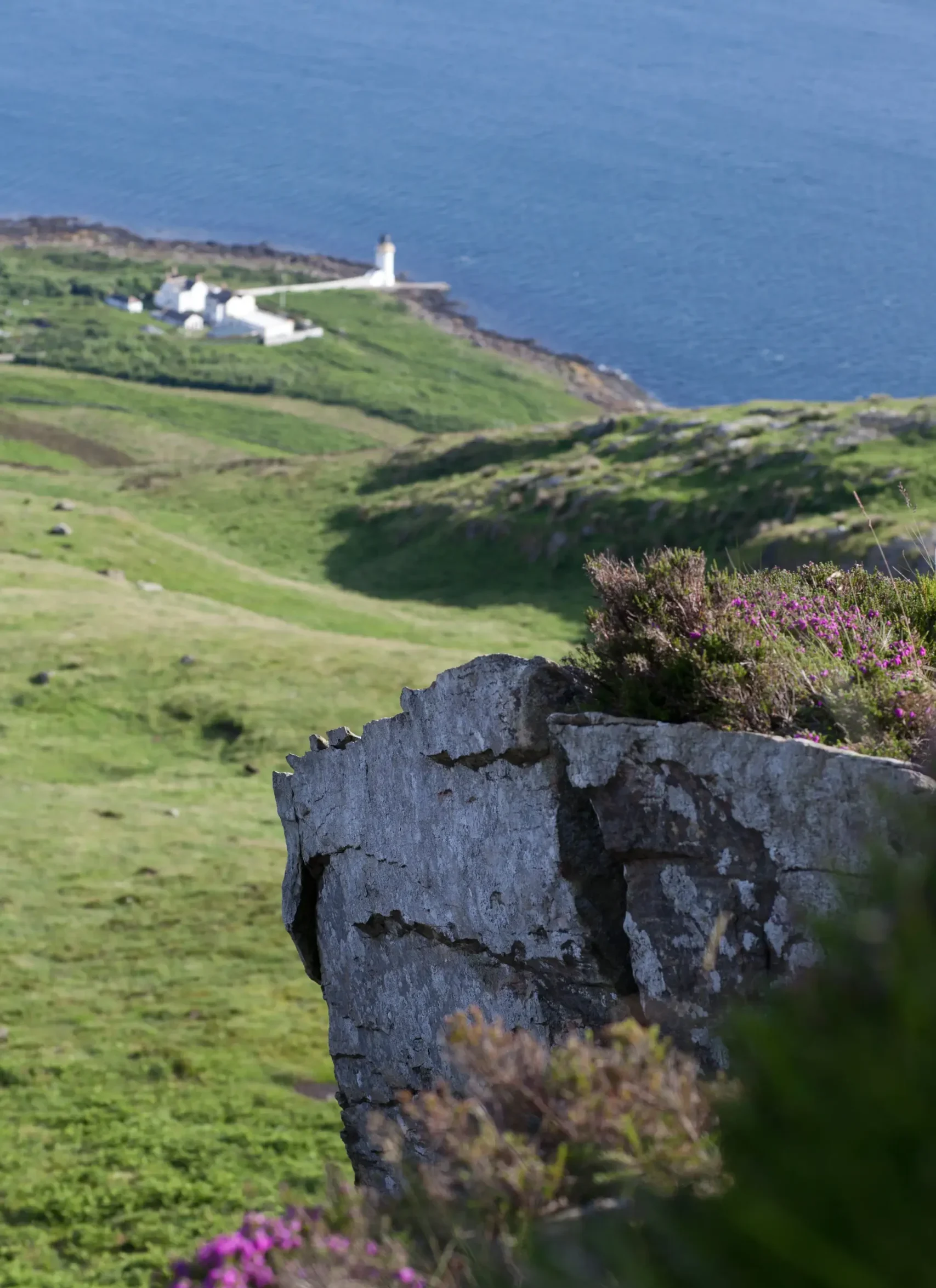
A closed Buddhist retreat takes place in the converted lighthouse cottages at the south of the island. The first one-year retreat started in 1995. The first traditional Buddhist three-year and three-month retreat on the island was completed in March 2006 by twelve women, followed by another three-year and three-month retreat which ended in 2014. Since then a few women have undertaken to do individual long retreats. In recent years the Inner Light Retreat has offered a space for closed, one-year ngondro retreats for women.
On Arran there are a further 21 retreat places for men. Long retreats started in June 2005 in Samye Dechen Shing, a purpose built retreat centre. Retreats have been ongoing since then.
Please note that as this is a long-term, closed retreat, no visitors are allowed to enter the clearly signposted gate to the retreat.
Rock Paintings
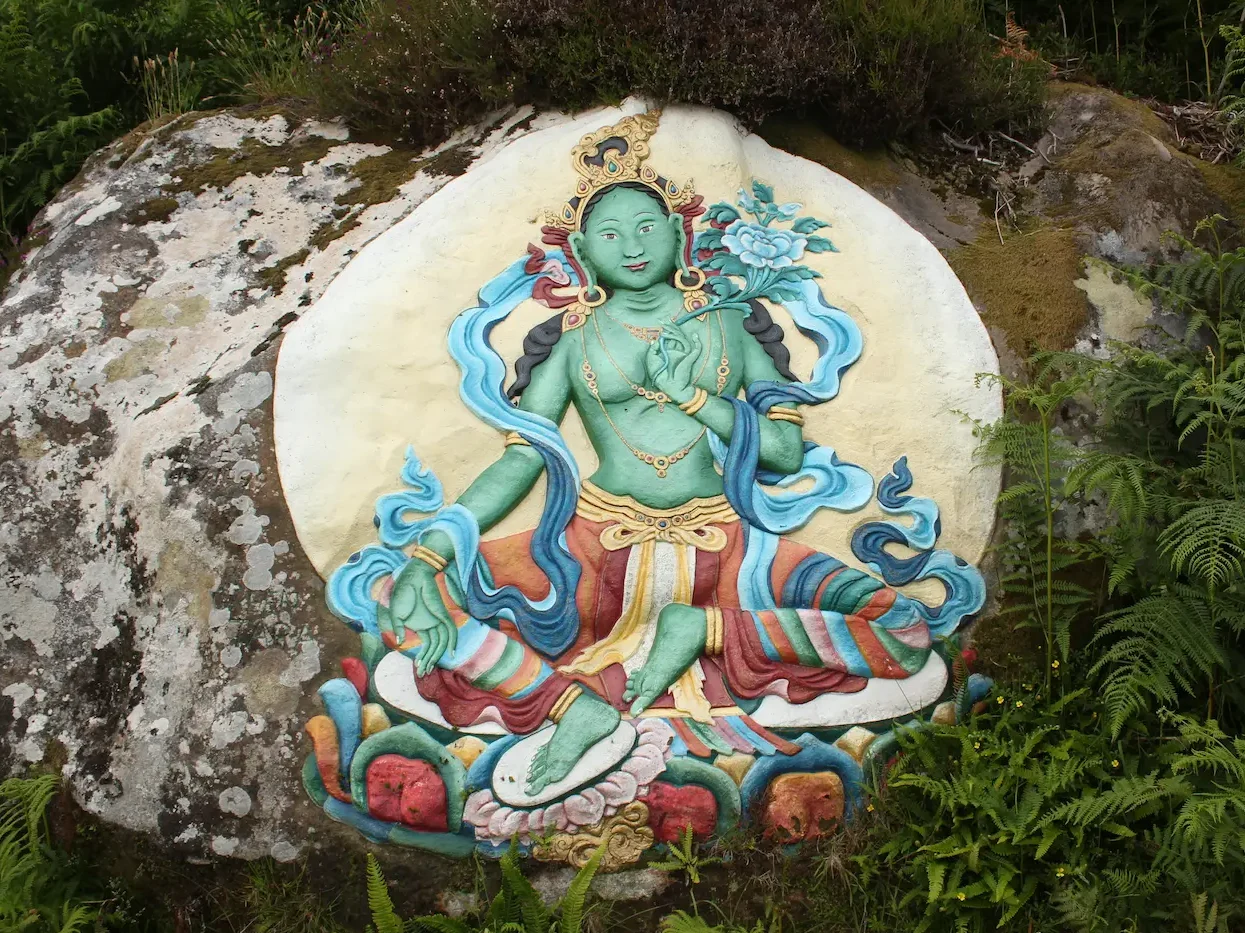
White Tara & Green Tara
If you walk from the Centre at the north down the path, you will first encounter White and then Green Tara. Tibetan Buddhism recognises many different tantric deities, each of which represents a different qualities of enlightened awareness. Tara is often seen and described as a Mother, because her compassion is so great that every being is as precious to her as a child to its mother. She is also described as Mother of all the Buddhas, because she is seen as the embodiment of perfected Wisdom.
In the form of White Tara, she can help preserve and protect one’s precious human life and cultivate wisdom. As Green Tara, she helps to overcome fear and to remove both external and internal obstacles on the path. She is quick and fearless in her activity – her outstretched right leg shows her readiness to spring into action whenever she is needed.
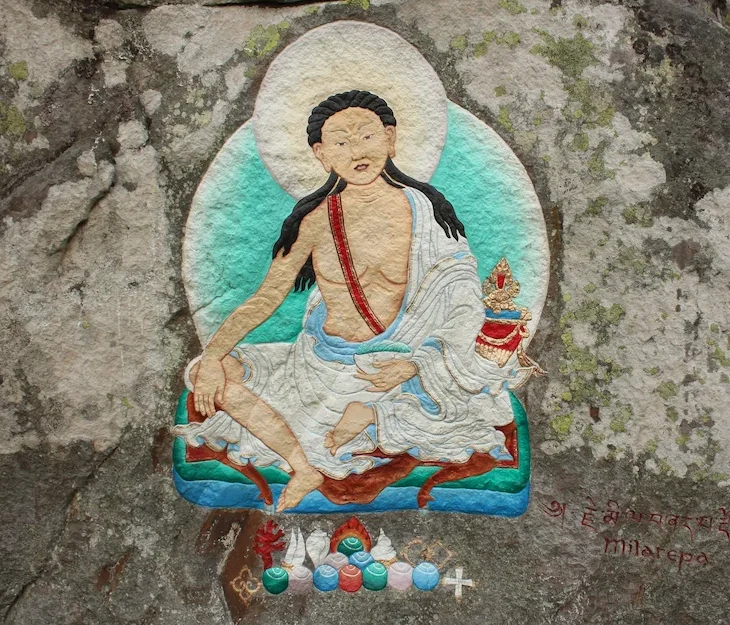
Milarepa
Milarepa (1052 – 1135) was a wandering yogi with quite an unusual life story: he killed many people in his youth, but through the power of his remorse and full-hearted practicing of the Buddhist teachings, purified his misdeeds and became the most well-known Tibetan Buddhist equivalent of “saint”.
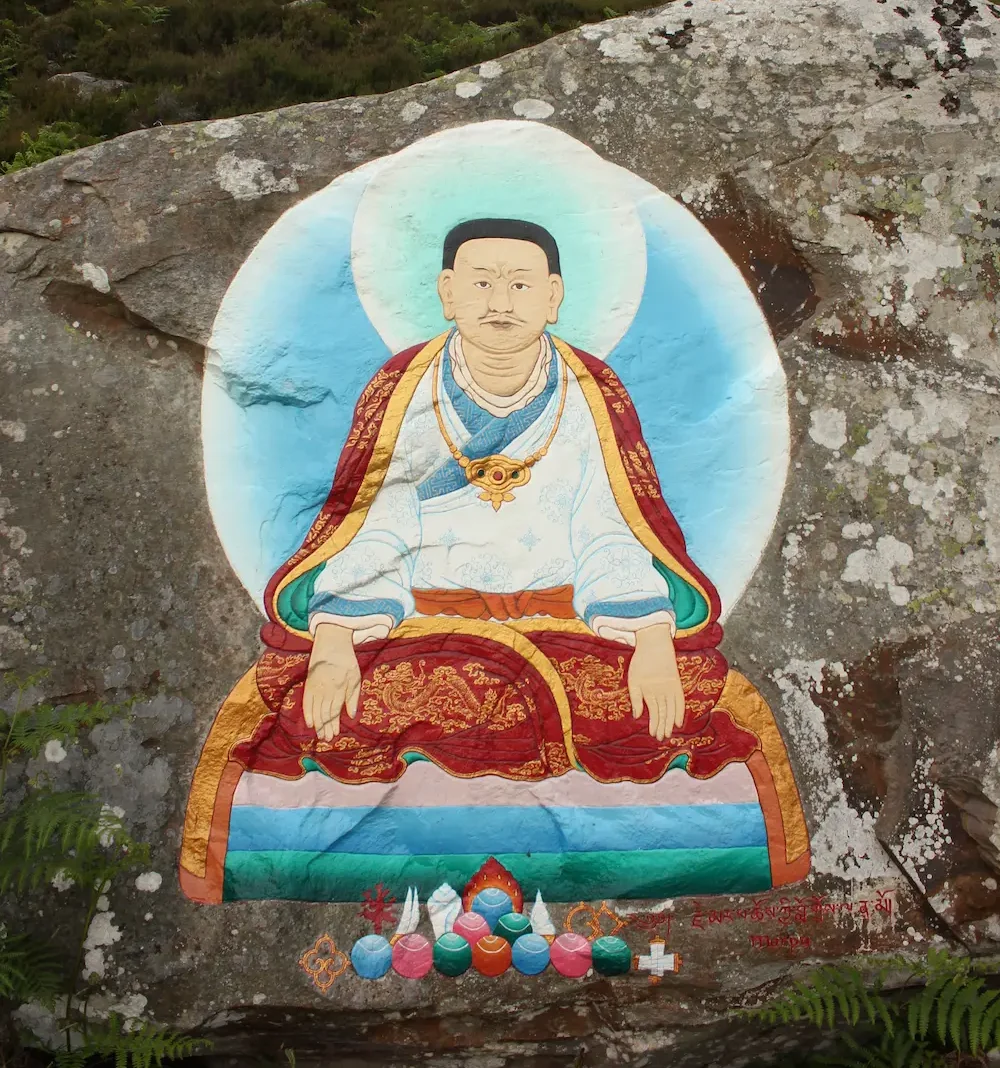
Marpa
Milarepa’s teacher is depicted on the next rock painting: Marpa ‘the Translator’ (1012 – 1097). A wealthy farmer, Marpa made three long and dangerous journeys from his homeland Tibet to India, to study with different teachers so he could bring the precious Buddhist teachings back to Tibet.
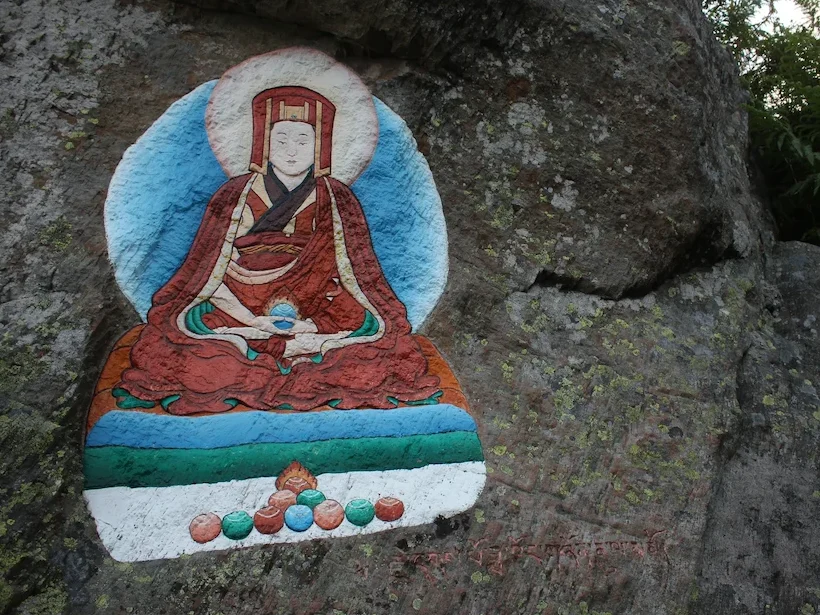
Gampopa
Gampopa (1079 – 1153) was Milarepa’s main student, but led a very different life from his teacher: originally a happy family man and renowned doctor, he became a monk after his family died of disease. After many years of practicing Gampopa founded a monastery which grew to legendary proportions, and thereby introduced the monastic tradition to the Kagyu Lineage.
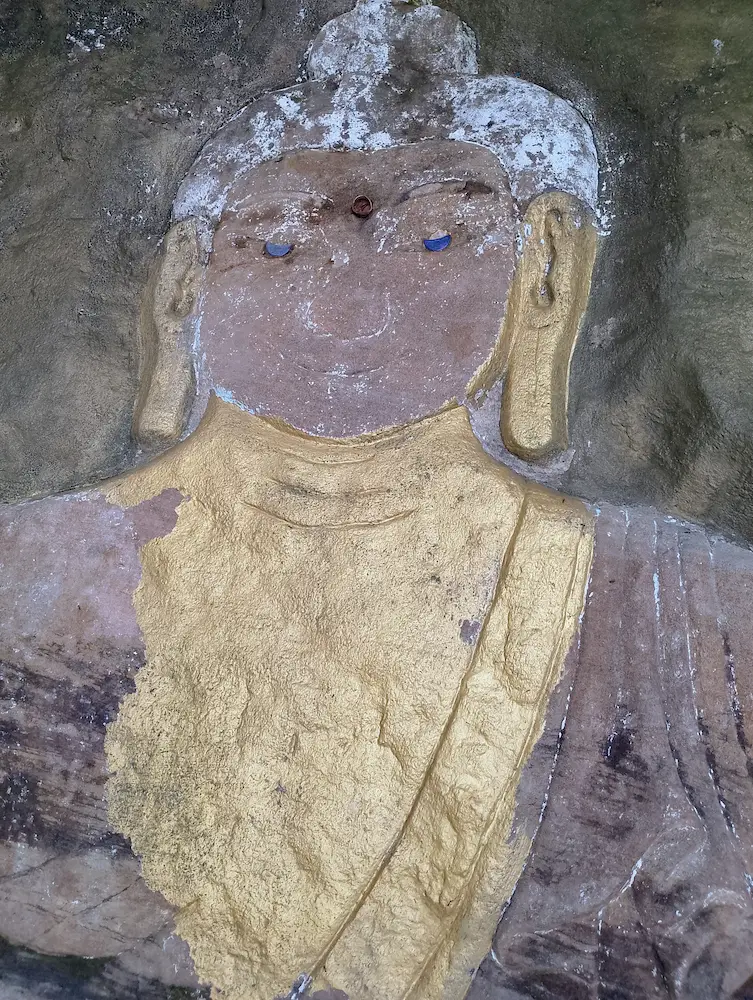
Buddha Shakyamuni
High up on the rock face you will find a depiction of Buddha Shakyamuni (560 BC – 480 BC), the founder of Buddhism as we know it. Originally a prince, he gave up his royal status when he encountered old age, sickness and death, to find the way to end all suffering. Today there are many different forms of Buddhism, such as Theravada, Zen, and Tibetan Buddhism. What they all have in common is that they are a way of living based upon a quest for inner peace and world peace, respect for others, dedication to the happiness not only of humankind but also of the animal kingdom and any form of sentient life, generosity, self-control and a deep love of knowledge. Buddhism does not believe in God as a creator but does believe in a powerful, pure and compassionate essence common to each and every being and known as Buddha nature.
This carving is currently undergoing restoration.
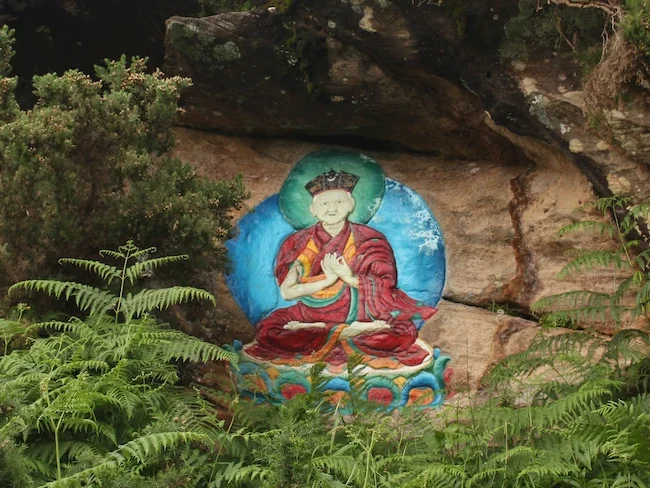
First Karmapa Dusum Khyenpa
The next rock painting on the path depicts Dusum Khyenpa, the first Karmapa (1110 – 1193). The most gifted student of Gampopa, the Karmapa made predictions about his future incarnations, who were to become known by the title “Karmapa”. Through the centuries, the Karmapa has been the head of the Karma Kagyu Lineage. The present Karmapa is the 17th in his line. His name is Ogyen Trinley Dorje and he turned 21 in 2006. He currently lives in India.
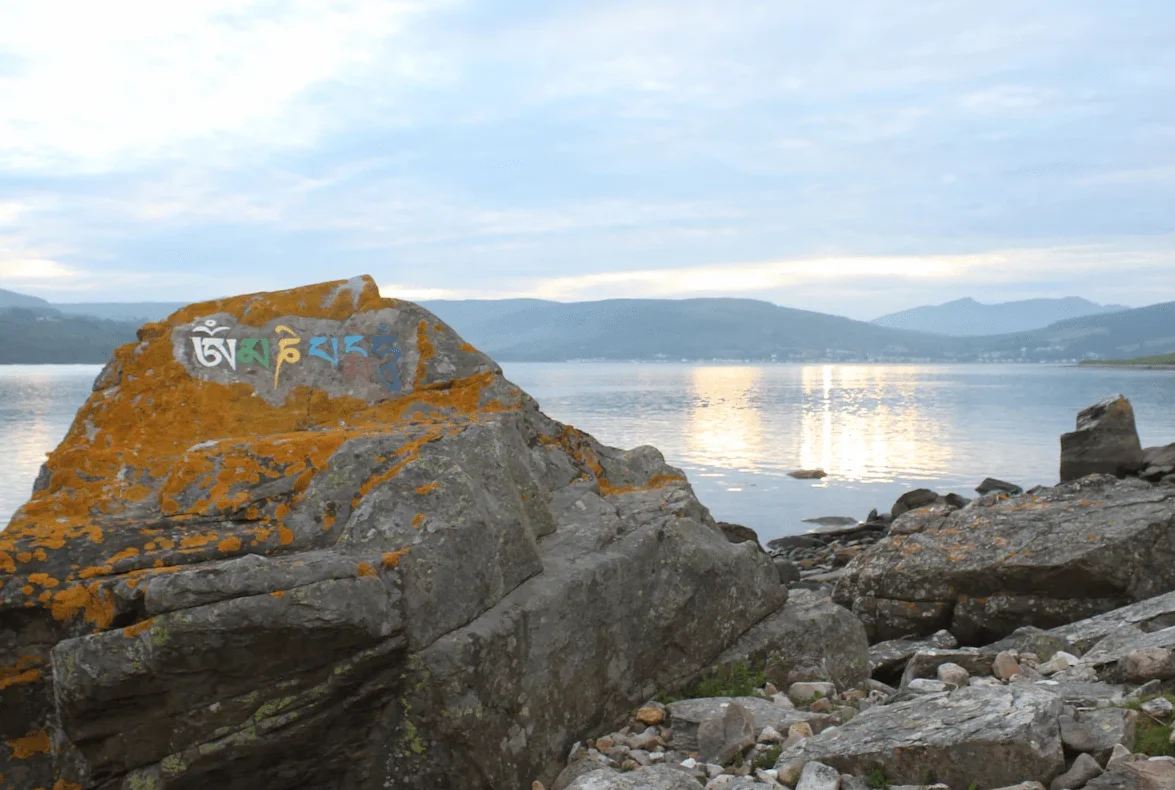
Mantras
Tibetan mantra syllables have been carved into the rocks near the retreat gates and along the path to the south. Like the rock paintings, this has an ancient history in Tibet, where there are walls or large piles made of stones that have mantras (prayers) carved on them. OM MANI PEME HUNG (pictured) is the most widely used of all Buddhist mantras, wishing peace and well-being to all sentient beings.
Prayer Flags
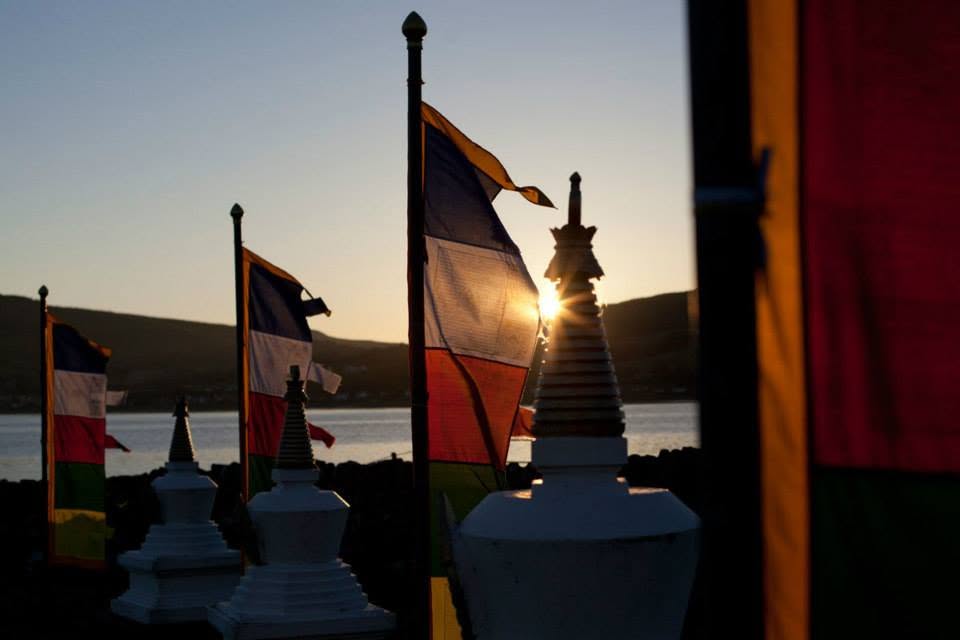
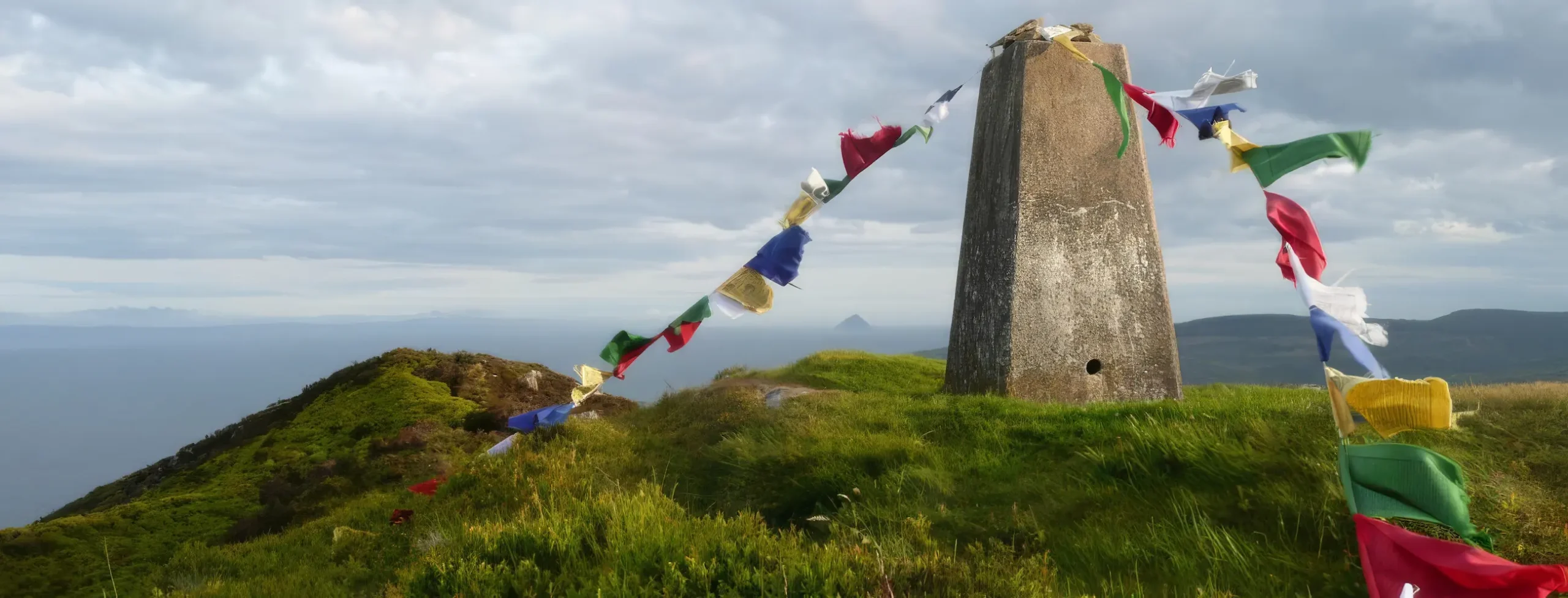
The multi-coloured flags in different places on the island are Tibetan prayer flags. The Tibetan word for them is dar cho: “dar” means to increase life, fortune, health and wealth; “cho” means all sentient beings. They are raised with the aspiration to bring happiness and peaceful energy, and the wind carries the prayers and blessings all over the world.
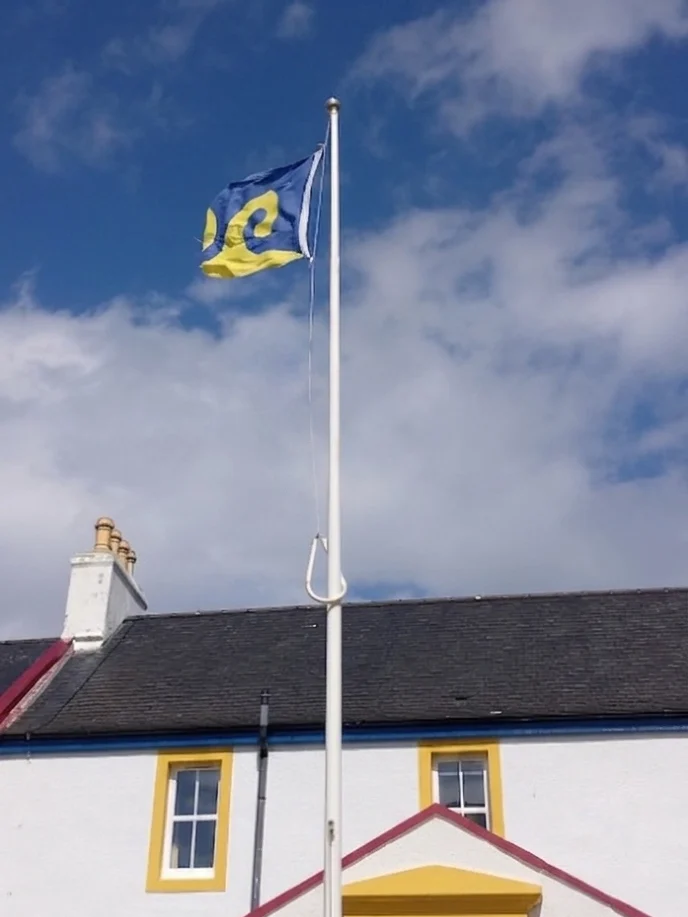
The Karmapa Flag
This flag was seen by the 16th Karmapa in a dream. He named it ‘Namkyen Gyaldar’, which means the ‘Victorious Flag of Buddha’s Wisdom’. On one level, the blue represents the sky (heaven), symbolizing spiritual insight and vision, and the yellow represents the earth, the actual world of our everyday experience. The symmetry of the wave pattern symbolises the Buddha’s teachings which flourish between the two. On another level, the blue symbolizes wisdom, while the yellow stands for compassion. The wavy line and the joining of the yellow and blue colours represent their inseparability.
Stupas
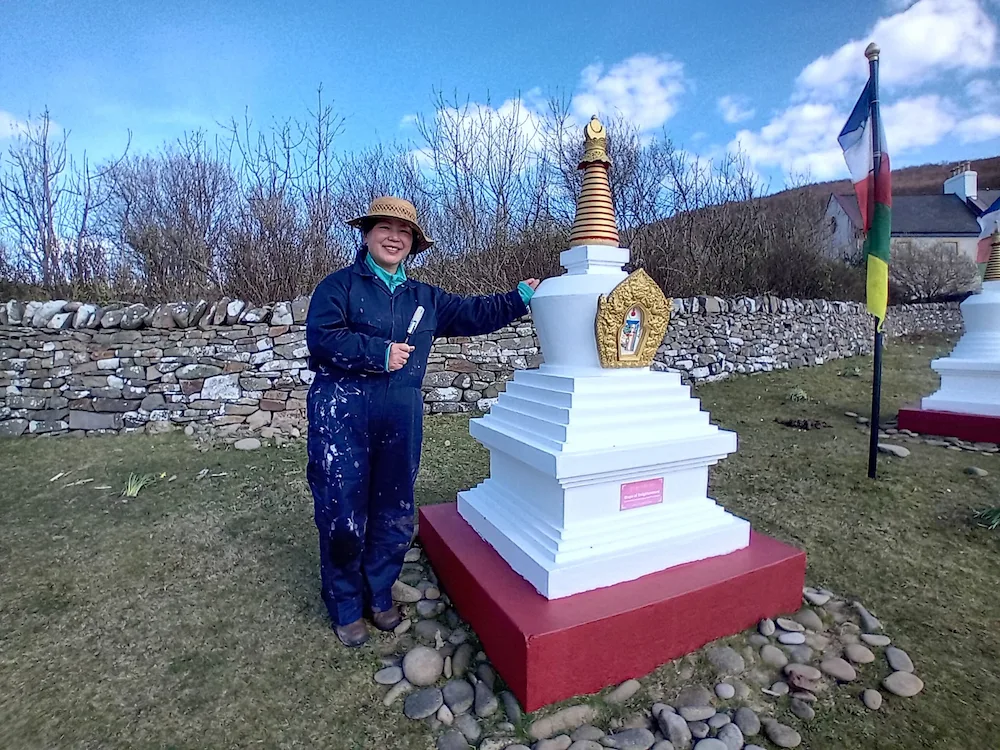
Eight small, white ornamental structures can be seen just after coming off the jetty. In Tibet, stupas can often be found at sites of special religious meaning, and are a focus for pilgrimage and prayer. A stupa is a symbol of the enlightened mind of the Buddha. Its function is to restore, balance and transform negative energies to heal both our planet and ourselves. The benefits of a stupa are said to be impossible to measure, for anyone, human or animal, who comes in contact with it, and even more when you mindfully walk around it three times clockwise.